What is “Quality Life”?

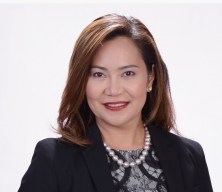
By: Bing Ledesma – De Los Reyes

Everyone wants quality life but what does that mean?

How do you define quality life? What is quality life for one may not necessarily be quality life for another as it is really relative. A common definition though is this – when we are able to do what we want to do for ourselves and for others…that is quality life.

Being able to do what we want to do for ourselves and for others…that is quality life.

For ourselves: being able to eat whatever and wherever we want; buy not only what we need but also what we want; travel wherever and whenever and do our hobbies and passions so we continue to be productive and feel good about it.

For others: when family members need help, we can always help; when family members and friends have special occasions, we can be there to celebrate with them; we’re able to help the community and be involved in church and social causes we believe in.

That’s how I define quality life and it does not happen like magic. You’ve got to work for it. Of course there are those who were born into affluence which makes the process easier but for most, it needs to be planned and worked out.

Mine is such. Born to a poor family, my parents had to work very hard to make both ends meet. I’m grateful for having parents who believe that being born poor is not our fault but to die poor, we only have ourselves to blame. We can work ourselves out of poverty.

Putting value in education is my parents’ way of giving us, their children, a chance to live a better life. Being diligent as a student was my way of honoring them; ensuring I utilize my capabilities at work is my way of glorifying God who made it all happen and incalculating good values in my family is my way of paying it forward.

So how do we ensure that we live our kind of quality life? That is where financial planning comes in. I firmly believe that no one can live a comfortable life at every stage without planning for it and if you start early, there is so much you can do. If you do it right, you increase your chances of having your kind of quality life.

So start planning and start early.
Laying the Blueprint for Financial Wellness

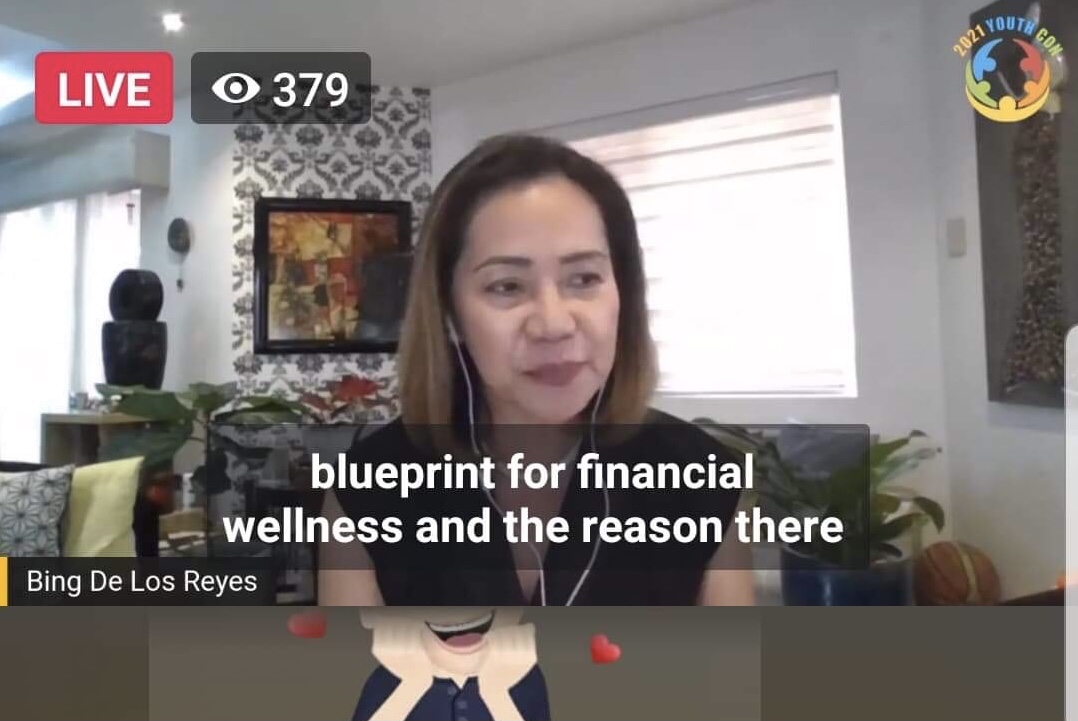
I was recently invited to share my thoughts with almost 400 delegates of the 1st Virtual Youth Congress organised by the Rotary Club of Makati Jose P Rizal. It was a mutually meaningful talk based on the feedback of the very engaged attendees and at my end, it was quite inspiring to do my own share of addressing the still prevalent “sandwich generations” among Filipinos.

I call it “sandwhich generation” when children take care of their ageing parents at retirement (because they have not prepared for it financially) while they take care of their obligation to their own family…thereby affecting also their capacity to prepare for their own retirement.

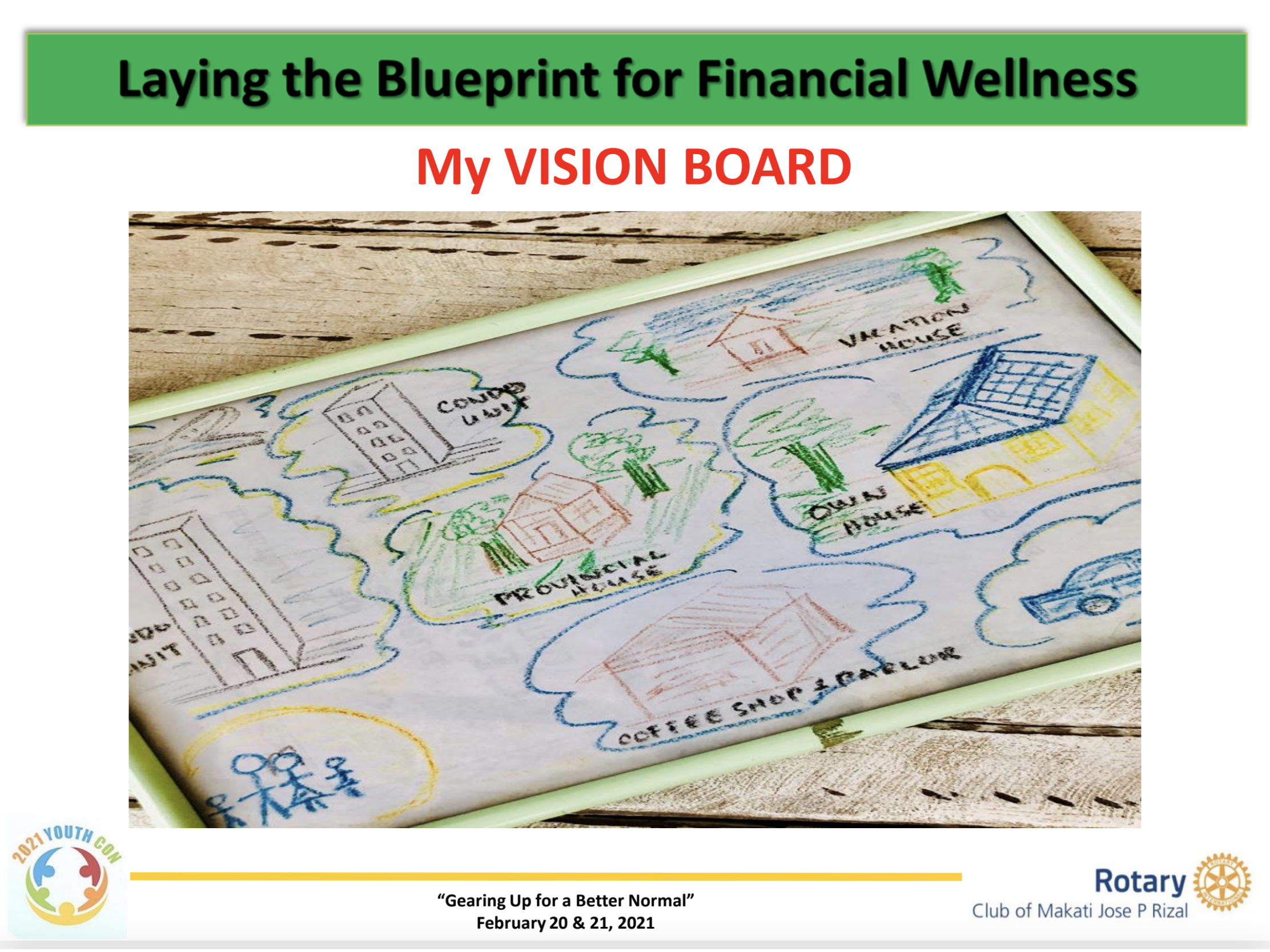
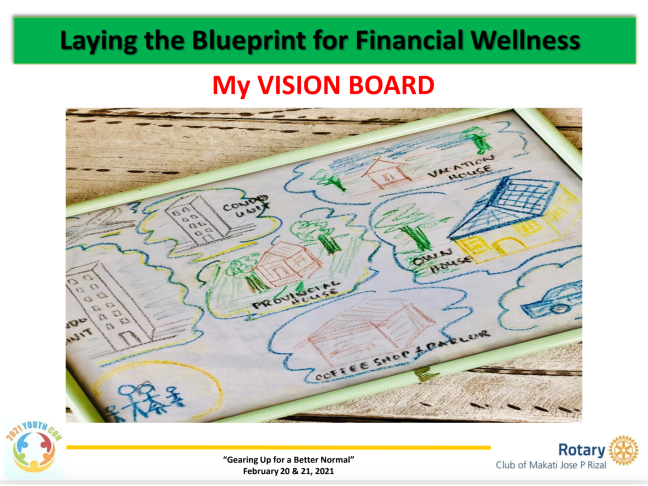
I shared with them my own vision board that I drew 22 years ago. It is a crude representation of the future that I then want but it has served as my guide and the basis for a more comprehensive financial plan that i diligently implement. I am happy to say that all except two goals (we were only blessed with one child and at my age, I can’t bear another one (sigh) and the brand of dream car that I now find impractical to buy).

My crude Vision Board reflecting the future that I want which I drew 22 years ago.

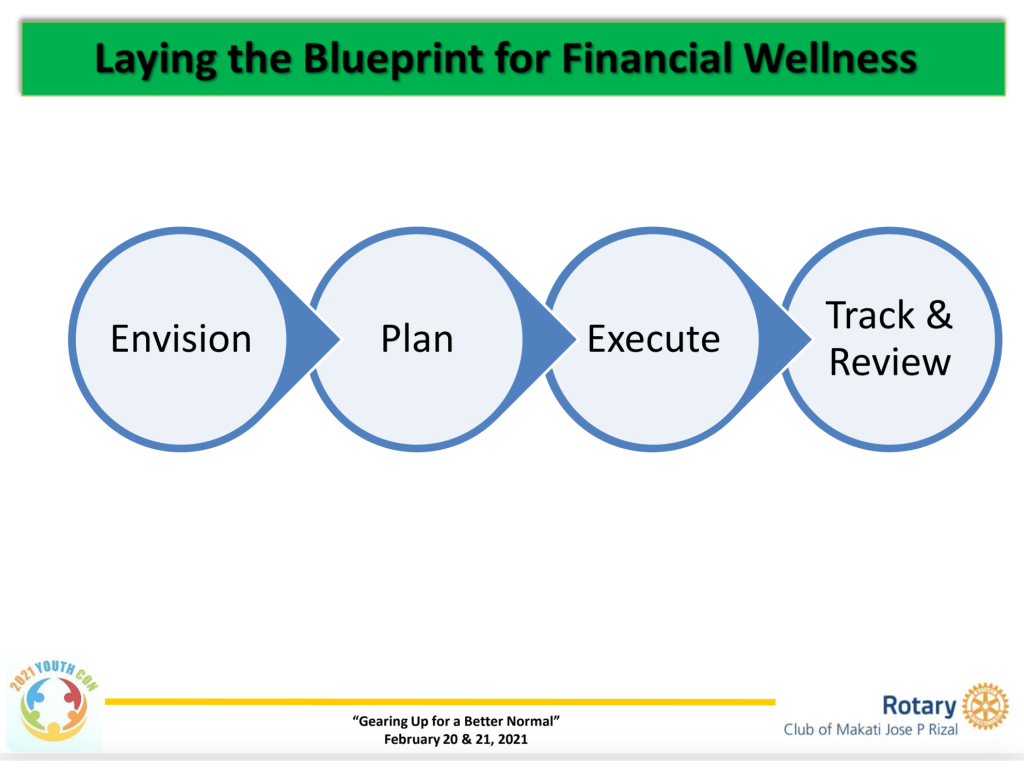
I outlined 4 steps as a guide in preparing one’s road map towards Financial Wellness:

  • Envision – Know what you want in every stage in your life. Visualise how the future looks like for you. Just the broad strokes.
  • Plan – Put a price tag to the future that you want. Once you know what you want, you can then determine how much fund you need to build-up between now and the time you need it. The key word is “build-up” which requires you to start early to take advantage of the time horizon where you can grow your money.
  • Execute – Start putting the elements of your Financial Plan. One thing we discovered about investing is that people generally have a mismatch of their goals and the investment vehicle they use. For example, a young couple wants to start early in setting up the college education plan for their 2-year old child and yet, they put their money in a savings account with little or negligible interest income. A basic principle in investing is that you can take more risks (ie invest in an equity fund that may be more volatile) if you have a longer time horizon.
  • Track and Review – Our goals and aspirations change so it is important to track and review where we are so far and make the necessary adjustments while we still have time.

I closed by reminding the delegates that their youth is their main advantage and they must not waste it by starting early and making the right choices.

Estate Planning…It’s not a copy-paste thing!

In my over 30 years in the financial services industry, I’ve encountered so many happy and sad stories on estate distribution and quite a number of these can be traced to wrong advice of simply “copying” what other family members or friends did with their properties or failing to make a wealth distribution plan.

Our values and goals as well as aspirations differ from others and as our circumstances change, some of these change too. Thus, it is important that we review our estate plan if we have started with it already or prioritise drafting it if we haven’t started yet. I am sure that the reason why we invest and accumulate assets is to live a quality life and ensure that our children as well as our children’s children live comfortably as well.

Many think that Estate Planning is only for the rich. No it is not! It’s for middle-class families like most of us who have started buying assets and the best time to think about what to do with these assets is while everything is going well with us. That way, a more thought-of and well-processed distribution may be carried out.

The following is a guide to start the process (credits to Martin Ledesma, a fellow veteran in the financial services sector who I consider an expert in this area having guided family corporations actually implement arrangements related to Estate Planning and Distribution):

  • Make an inventory of your Assets (indicate the estimate value of each)
  • Know which ones you own and which ones you co-own (by virtue of the property regime in place at the time of the celebration of your marriage which dictates the ownership of these assets).
  • Decide which ones you keep and which ones you will transfer now (depending on the purpose of the assets: is it to be used as your passive income when you retire or is it something you can transfer now to your child/children as something you want them to have or is it both of these?)
  • Devise a plan on what to do with the ones you keep (considering their function to you and your loved ones) and provide for payment of estate taxes (a life insurance policy enough to pay the estate taxes due is your best option; make sure you provide enough life insurance for the needs of your family too especially if your kids are still young).

Estate Planning is not only about reducing taxes but more importantly, it’s about keeping the family ties intact for what good are our riches if your family ends up not talking to each other anymore?

Prepare your estate while you’re around to give your family the wisdom that only comes from you and the life you lived.

For a more comprehensive reference on Estate Planning in the Philippine context, I highly endorse the book “Thy Will Be Done” by Atty. Angelo Cabrera, whose field of practice is Estate and Business Succession Planning. His book is written in a very interesting manner complete with real-life stories. (It is available at Amazon).